Swine teaching and research facilities receive nursery building upgrades
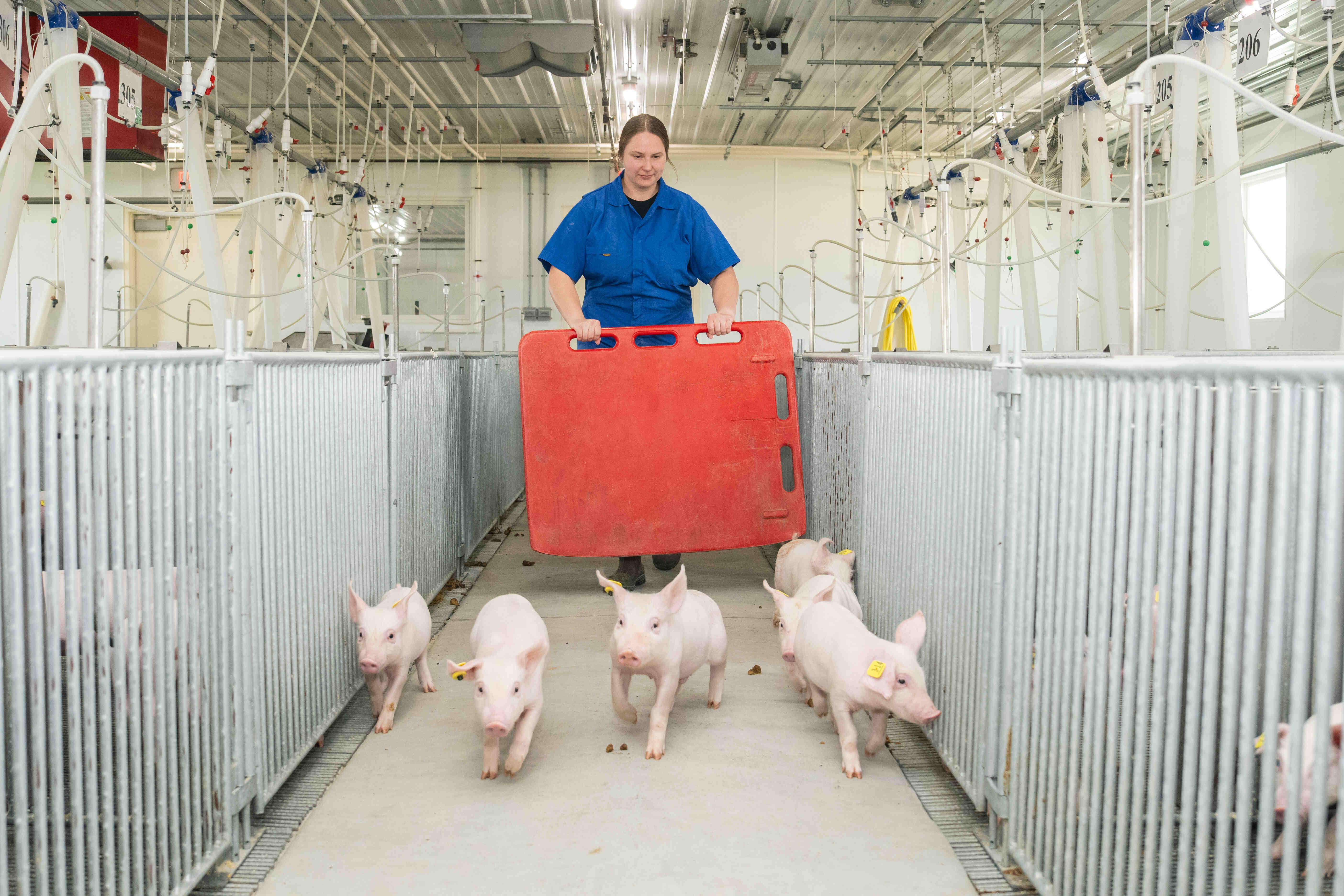
Kansas State University prides itself on hands-on learning and real-world research collaboration. To accomplish both, it’s essential to have teaching and research facilities close to campus and up-to-date. Just north of the Manhattan campus are the K-State Swine Teaching and Research Center and the Swine Early Wean Nursery Facilities. A new nursery at the K-State Swine Teaching and Research Center houses 96 pens and conducts research on nutrition strategies and growth performance in nursery pigs.
Dr. Joel DeRouchey, K-State professor and state swine extension specialist, focusing on swine nutrition and management, explained that pigs enter the facility shortly after weaning at about 21 days of age and remain there for approximately seven weeks. During that time, the team focuses on advancing swine nutrition and management by studying growth, efficiency and overall health.
Opening its doors in the spring of 2025, the new nursery facility replaced a decades-old building that was established in the early 1970s.
“While it was still representative of commercial swine production, this new one takes it to a new level,” DeRouchey said. “Being able to use the exact same gating, flooring, feeder types and water types really helps us teach commercially relevant material and conduct strong research.”
Sierra Collier, a graduate student in animal sciences and industry, said that while the old nursery had served the research team well, the industry is always evolving and the upgrades are a big advantage to K-State students.
“As we are constantly discovering new applications, facilities need to stay current with the industry standards,” she said. “The new nursery offers improved housing conditions with more pens to house weanling pigs and updated ventilation systems for continued research and data collection.”
The upgrades made to the facility will impact research in core areas of swine nutrition and management research. DeRouchey said the team has already conducted a variety of trials, including work on feed budgets. Pigs receive multiple diets during the nursery stage, and one graduate student recently studied how adjusting feed amounts from weaning through late nursery affected growth and efficiency. The team has also begun testing a water additive product delivered through the water lines to support pig nutrition during the nursery period.
DeRouchey noted that the modernized space also enhances industry partnerships and helps companies refine nutrition strategies.

“We continually partner with companies to help them answer questions they have as they further refine the recommendations of the different feed additives or nutritional products, protein products, refined soybean meal products, all the different protein and lactose sources that we could utilize for nursery pigs,” said DeRouchey. “This is definitely a very good opportunity for companies to partner with us to evaluate existing products or those in their pipeline that they would like to learn more about.”
The unit has a lot of support from swine producers in Kansas and throughout the United States. DeRouchey credits this to the land grant mission and the units' research and outreach serving the nation. Because of this, they’ve been fortunate to receive much of their funding for upgrades to facilities like this one from producers and industry groups.
Five key supporters made the new nursery building possible. K-State’s Applied Swine Nutrition Team and College of Agriculture led efforts to raise $1.5 million in funding. The Kansas Board of Regents provided funds to demolish the old facilities. The Livestock and Meat Industry Council and the Kansas Pork Association also contributed, with the pork association’s donation funding the purchase of teaching and research equipment.
The new nursery facility impacts more than teaching and research; it’s become a key asset in animal science recruiting at K-State. It’s also not the first building to be modernized within the swine research facilities.
DeRouchey explained that through a 4 million dollar fundraising effort and reinvestment, the department has replaced all of the original swine buildings over the past 25 years. Each update has created modern facilities that, while smaller than commercial operations, closely replicate the same equipment and environment. Students gain practical experience from their first day on site and leave with a strong understanding of how swine systems operate.
“It’s a great opportunity to recruit prospective students at both the undergrad and graduate levels,” Collier said. “Undergrad students have the opportunity to take swine science classes, research courses and work on the farm or in the lab, which gives them hands-on experience in animal care, research and data collection. Graduate students can design and lead trials using our controlled research facilities that mirror commercial systems.”
She noted that the facility will continue to set K-State apart as a research-focused university and reinforce the value of hands-on learning
“As a land-grant university with the animal units so close to campus, students have daily access to various hands-on experiences, which I consider one of the College of Agriculture’s biggest strengths,” Collier said. “There is a strong sense of purpose and mentorship in every class, project or trial. Unique opportunities like this provide students with skills to become future leaders within the swine industry.”