Rocky Ford Turfgrass Research Center: Growing a Legacy for Innovation
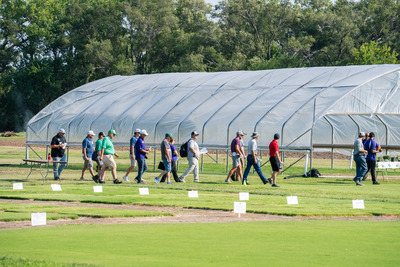
The Rocky Ford Turfgrass Research Center advances turfgrass research and education at Kansas State University, supporting science-based solutions for golf courses, sports fields and managed landscapes across the region and beyond. The center plays a key role in the university’s land-grant mission by generating research-based knowledge that improves turfgrass performance, reduces inputs and supports industry innovation.
Research at Rocky Ford is designed to reflect real-world conditions, with projects organized into individualized irrigation zones that allow researchers to evaluate turfgrass performance under a wide range of management and environmental conditions. These flexible research systems enable faculty, students and post-doctoral scientists to conduct field-based studies that translate directly into practical recommendations for the turfgrass industry.
Located three miles north of the K-State campus, the 11-acre center includes research plots, a Quonset hut, a chemical storage shed, an automated rainout structure, a stationary drought/rainout structure and 51 automated irrigation zones. Both cool-season and warm-season turfgrass species are maintained on site, enabling year-round research and long-term evaluation of turfgrass systems under Kansas conditions.
The Rocky Ford Turfgrass Research Center was shaped by the leadership of Dr. Jack D. Fry, who recently retired after a distinguished career in turfgrass science at Kansas State University. As he transitions from researching turfgrass varieties to spending more time enjoying them in retirement, Fry leaves behind a stronger turfgrass management program, expanded research capacity at Rocky Ford and a nationally recognized foundation for future research.
“The K-State turfgrass program is very strong, and I look forward to watching it grow,” Fry said. “As I transition out of my role as director and into retirement, I am excited to watch students and our program as a whole continue to grow and conduct research that can help our industry thrive. We have an incredible facility here that is going to help us make great advances in the turfgrass industry.”
Fry’s interest in horticulture began at an early age and led him to enroll at K-State in 1978. After receiving his master's and PhD, he joined the K-State faculty in 1991, where his research focused on developing and managing turfgrass species that require fewer inputs.
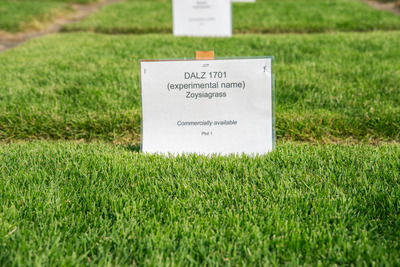
“I have had a lot of interest in working with zoysiagrass over the years,” Fry says. “It has impressive performance on golf courses across the country and a lot of opportunities to develop new varieties. I have worked with managing other cool- and warm-season grasses, but there is no doubt that zoysiagrass captured my time and interest over the years.”
Zoysiagrass, Fry explained, offers significant benefits for turf managers due to its performance under heat stress and reduced input requirements. As a warm-season grass,
it thrives during Kansas summers. It requires fewer pesticides, less frequent mowing and lower fertilizer inputs than many alternatives—reducing both management costs and environmental inputs while maintaining high performance on golf courses and other managed sites.
Building on the strong foundation built by Fry, Dr. Ross Braun, K-State assistant professor of turfgrass and landscape management, now leads the Rocky Ford Turfgrass Research Center. Braun's research continues to emphasize zoysiagrass, input efficiency and turfgrass performance, with applications ranging from commercial turf operations to residential landscapes.
“Some of my current research focuses on newer zoysiagrass experimentals developed through K-State’s collaboration with Texas A&M University and Purdue University,” Braun said. “This three-way partnership allows us to evaluate experimental grasses with potential for commercial release in the next three to four years, comparing their performance to currently available varieties under Kansas conditions.”
In addition to warm-season turfgrass research, Braun is advancing cool-season sod production by evaluating species mixtures to improve performance, durability and management efficiency.

Beyond research, Braun emphasized the center’s role in preparing students for careers in the turfgrass industry. Through hands-on experience managing research plots and turf systems, students gain practical skills while seeing the direct and long-term impacts of their work.
“You’re managing an entire plant system that has tremendous benefits—whether that’s a golf course that provides a venue for golfers and environmental benefits, sports fields for people to play on or quality home lawns for homeowners,” said Braun. “You can see the impact of your work immediately, not just in maintaining the site, but also in the long-term impact of providing green space for people. It’s really rewarding for students entering the turfgrass industry.”
As director, Braun plans to continue building on the legacy established at Rocky Ford—expanding research, strengthening partnerships and supporting the next generation of turfgrass professionals.
“I’m excited to step into this role, continue some of Dr. Fry’s research and keep growing the connections and collaborations that make this program successful,” Braun said.
Together, faculty, students and industry partners at the Rocky Ford Turfgrass Research Center advance Kansas State University’s land-grant mission through integrated research, teaching and extension. As the center looks ahead, it remains focused on translating science into practice, preparing students for the turfgrass profession and delivering solutions that meet the evolving needs of homeowners and the turfgrass industry.