Smarter Supplementation: Exploring a New Tool for Stocker Efficiency
By Emerson Tarr, Graduate Research Assistant
Conversations around cattle production increasingly focus on efficiency and sustainability, but for producers, those conversations often come down to practical questions surrounding cattle performance, profitability, and management decisions. The team at Rannells Ranch is studying how feed supplementation may improve cattle performance while reducing methane emissions in grazing systems.
Master’s student and graduate research assistant in Animal Science and Industry, Jace Owen, is studying how feed supplementation strategies may help producers improve cattle efficiency and better understand methane emissions under real-world grazing conditions in the Flint Hills.
“We’re trying to be the most efficient we can,” Owen said. “Methane as a whole is just an energy loss.”
Owen’s interest in cattle nutrition developed through his experiences growing up in Canyon, Texas, and later studying animal science at Texas A&M University. His passion for ruminant nutrition, cattle efficiency, and methane mitigation eventually led him to Kansas State University and research connected to Rannells Ranch. Owen works under the guidance of Logan Thompson, director of Rannells Ranch and assistant professor of animal science, and Jason Warner, assistant professor and extension cow-calf specialist in animal science.
“What really drew me in was the methane mitigation work and overall cattle efficiency research happening out here [Rannells Ranch],” Owen said.
Previous studies conducted at Kansas State and involving Agolin have primarily focused on dairy and feedlot cattle fed total mixed rations. This study, however, evaluates how the product performs in grazing systems, where cattle consume high-forage diets and methane emissions are generally higher.
The project uses 120 stocker steers grazing approximately 240 acres at Rannells Ranch. Half of the cattle receive a standard distillers grain supplement, while the other half receive distillers grains mixed with Agolin, an essential oil blend, to evaluate how the supplement affects methane emissions, cattle efficiency, and average daily gain.
“We know that methane is increased during these grazing systems and grazing practices,” Owen said. “Being able to use this product on these stocker calves and see the impacts of a high-forage diet mixed with Agolin is what makes this research really interesting.”
To conduct this study, the research team is using a precision supplementation trailer called the SmartFeed Pro system. The technology reads RFID ear tags and controls how much supplement each steer consumes daily. Another system, GreenFeed, measures methane, oxygen, and carbon dioxide emissions while cattle eat.
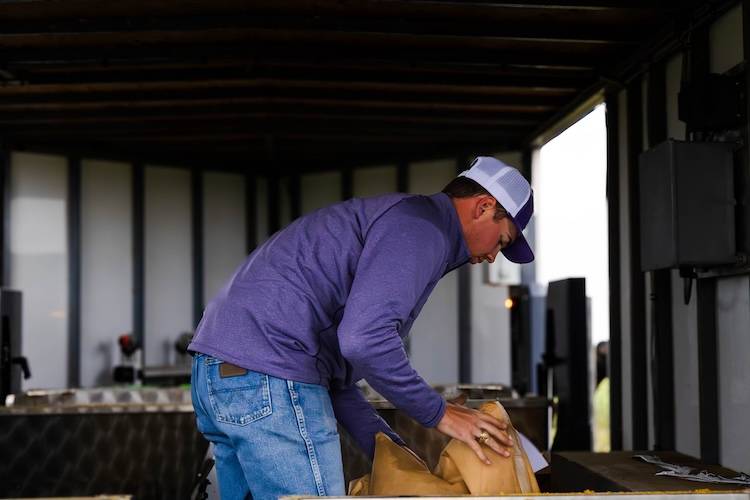
Along with methane emissions, the team is tracking forage quality, dry matter intake, supplement intake, and average daily gain.
“At the very least, we want to maintain the same average daily gain,” Owen said. “But we do hope for an increased average daily gain with this Agolin product.”
The study is also designed to better represent real grazing conditions. Previous grazing trials had smaller sample sizes. By doubling prior livestock sample size, the team hopes to create a clearer picture of how larger groups of cattle perform with the supplement and pasture conditions.
“Producers are going to have larger cattle herds on these grazing systems,” Owen said. “We want to capture what’s actually happening out there.”
For Owen, conducting research at Rannells Ranch is important because the ranch mirrors many of the same challenges producers face daily. Weather, pasture conditions, cattle management, and infrastructure all influence the success of both the research and the cattle operation itself.
“One day we had a storm roll through and tear down fences,” Owen said. “That’s a problem producers have to go through, and it’s something we have to go through here too.”
Ultimately, Owen sees the project as a way to provide producers with practical information they can apply within their own operations while continuing to improve cattle efficiency and productivity.
“We want to bring knowledge to the industry,” Owen said, “and provide producers a way to enhance their herd and make more profit every year.”