Why Measuring Methane Matters for Grazing Cattle in the Flint Hills
By: Emerson Tarr
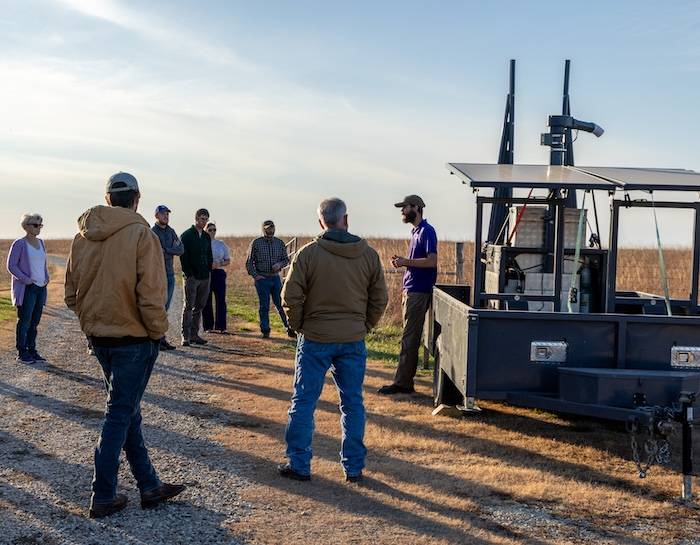
Methane released by grazing cattle is something we cannot see, but it plays a growing role in how people evaluate beef production. At Rannells Ranch, researchers are working to measure methane more accurately in pasture systems and understand what it means for producers, consumers, and the future of the industry.
According to Logan Thompson, assistant professor of animal science at Kansas State University and director of Rannells Ranch, the challenge starts with simply understanding current conditions. “If we don’t know where we are, it’s hard for us to find improvements over time,” Thompson said. Without a baseline, it is difficult to evaluate how grazing management changes impact both beef production and environmental outcomes.
Methane is a natural part of cattle digestion, and Thompson explains how it also provides insight into how well cattle perform. “It’s a marker for fermentation efficiency in the rumen and also for the overall efficiency of production,” he said. This means methane is something that helps researchers understand how efficiently cattle convert grass into protein.
One of the biggest challenges to understanding cattle efficiency is measuring methane in a grazing system. Pastures are constantly changing. Variable forage quality, livestock movement, and grazing behavior all influence emissions, making it difficult to accurately capture a full picture.
To address this issue, Thompson and his team are using a portable system that measures methane while cattle are grazing in the natural pasture system. Collected data reflect real-world conditions, and by understanding the impact of emissions on a real system, researchers can better evaluate how management decisions affect both efficiency and environmental outcomes.
Thompson says the goal of the research is to provide information that helps producers. “Our producers need to have options so that they can make decisions,” he said. Whether it is grazing management or cattle sourcing, better data can help reduce uncertainty and improve outcomes.
Despite the complexity of the issue, Thompson sees the work as necessary and ongoing, where progress comes from building knowledge over time and continuing to improve, which he believes is a responsibility of the industry itself.
“This is beef production,” Thompson said. “And we’re working to improve it.”