Measuring Methane to Understand Grazing Systems at Rannells Ranch
By: Emerson Tarr
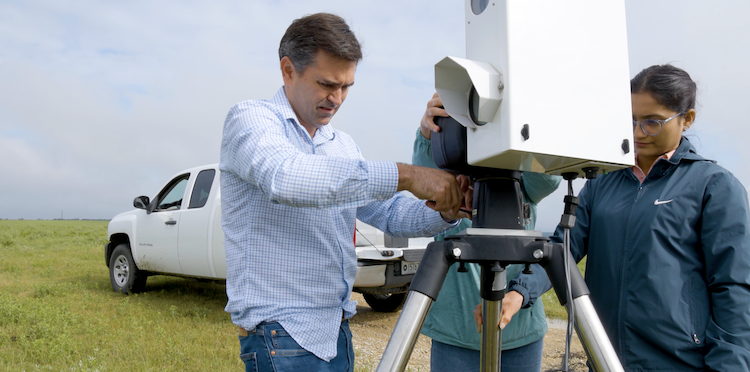
Accurately measuring methane emissions from grazing cattle remains one of the most challenging issues in agricultural and environmental research. At Rannells Ranch, researchers are therefore rethinking how methane is measured in pasture-based systems and why those measurements matter to producers, policymakers, and the public.
According to Eduardo Santos, associate professor of micro-meteorology in agronomy, the problem begins with the limitations of traditional measurement methods. “We don’t have a very good way to measure methane in the pasture at the moment,” Santos said. Most existing approaches rely on devices that sample the breath of individual animals, producing estimates based on brief, isolated moments. In reality, methane emissions vary over time and between animals, influenced by diet and grazing behavior.
Santos emphasizes that point-based measurements fail to capture the complexity of grazers and grazing systems. “If you’re just capturing a point for one animal in time, you’re not capturing the animal-to-animal variability, [and] you’re not capturing the variability of those emissions,” he said. Without accounting for that variability, emission estimates may not accurately reflect real-world grazing systems.
To address this challenge, Santos and his collaborators are using laser-based technology that continuously monitors methane across an entire pasture. By capturing emissions constantly, the system provides a more realistic picture of how methane fluctuates under normal grazing conditions. This approach allows researchers to better connect methane production to management practices and environmental factors rather than relying on assumptions or short-term measurements.
Accurate measurement matters beyond research. Better data will show how efficient grazing systems are and help prevent broad estimates from being applied to specific regions. Reliable measurements can also inform policy decisions and may help Flint Hills ranchers better understand how emissions affect grazer and grazing system efficiency and profitability. As Santos said, with more accurate data, “you don't run the risk of somebody on the other side of the world coming up with some general emission factors and applying them to Kansas.”
Despite the complexity of the work, Santos views it as impactful. “It’s difficult and it’s important,” he said. “If you don’t have a good understanding of the problem, there’s no way you can solve it”.