For more than 150 years, Kansas State University has turned agricultural science into solutions the world depends on — from sustainable, regenerative farming practices to genetic breakthroughs that grow productivity and build resilience against drought, disease, and a changing climate. Today our researchers are racing to help feed two billion more people by 2050 — and we're building the partnerships to get there.
$17 — returned per $1 invested in research
$264.9M — in FY24 research spending
No. 5 — nationally in agricultural sciences
Four reasons the world's toughest agricultural challenges get solved here.
Kansas isn't just where we do research — it's our advantage. Our fields mirror growing conditions found on nearly every non-arctic continent, and our facilities span the full spectrum from greenhouse to biosafety level 3 laboratory. Combined with a One K-State approach that connects agriculture, veterinary medicine, engineering, business, and health sciences, we give partners a single front door to problem-solving at scale.
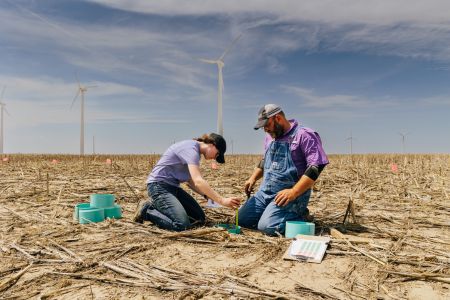
A living testbed. Kansas's range of soils, elevation, and climate lets us model growing conditions found around the globe — from the field to the lab.
One of a select few universities with access to a complete continuum of biosafety laboratories, including the BSL-3 Biosecurity Research Institute and a close working partnership with the $1.25 billion National Bio and Agro-Defense Facility.
One K-State, one team. Agriculture, Veterinary Medicine, Engineering, Business, and Health & Human Sciences work side by side on shared challenges — no silos, no hand-offs.
Talent built in. A No. 5-ranked, hands-on college that trains the workforce our partners will hire tomorrow.
A $210 Million Investment in the Future of Agriculture
Agriculture Innovation Initiative
The Agriculture Innovation Initiative is the most significant investment in K-State Agriculture's history — new and reimagined facilities for grain and food, animal systems, and agronomy research, backed by a 3:1 matching commitment from the State of Kansas.
Our research is organized around the areas where Kansas's strengths and the world's greatest
agricultural challenges meet — from the animals and plants we study to the people we train to carry the work forward.
Animals & Animal Systems. From genetics to production and animal health, we advance the science that keeps livestock systems productive, sustainable, and disease-resilient.
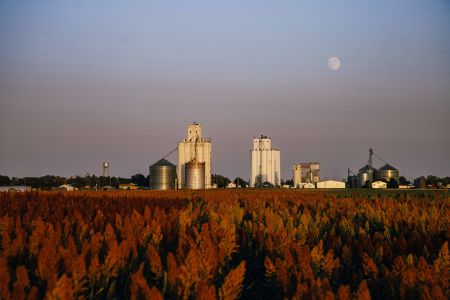
Grain and Food Systems. Home to the Hal Ross Flour Mill, the International Grains Program, and feed-safety labs that turn Kansas grain into safer, better food and feed worldwide.
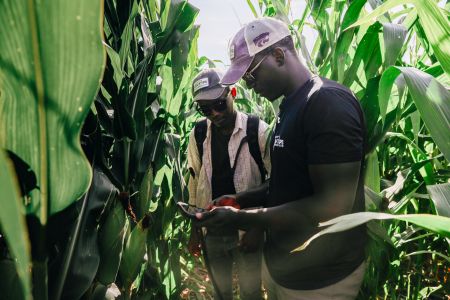
Plants & Plant Systems. Breeding, genetics, and crop management research that builds resilience against drought, disease, and a changing climate.
Sustainability, Profitability & Management. Economic and environmental research that helps producers and industry do more with less — protecting natural resources while strengthening the bottom line.
Data & Agricultural Systems. Research in precision agriculture, automation, sensors and data analytics helps producers make better decisions, improve efficiency and use resources more effectively.
Discovery, As It Happens
105 Counties. One Research Network.
Kansas stretches from humid eastern forests and tallgrass prairies to the semi-arid high plains of the west — a range of soils, precipitation, and growing seasons few single states can match. Our statewide network of research centers, experiment fields, and extension offices puts that diversity to work, and what we learn here feeds research partnerships that reach well beyond Kansas.