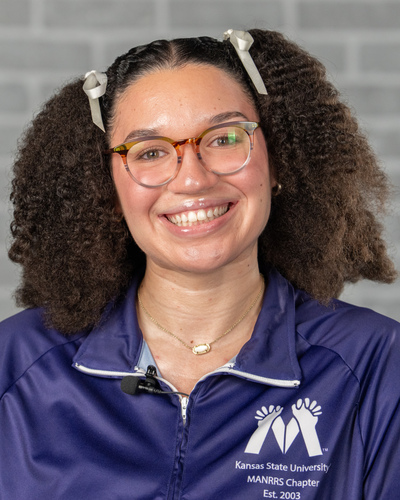
Meet Selena Gilyot - A Texan exploring new paths in Manhattan, KS
Major: Master’s in Public Health in Veterinary Medicine, Bachelor’s in Animal Sciences and Industry
Expected graduation year: Spring 2026
Hometown: Houston, Texas
As an out-of-state student, what made you decide to attend K-State?
I always knew I wanted to go out of state. I didn’t want to stay in Texas, and for a while I thought I would go to school in Louisiana. Then I heard K-State had a veterinary school, and my dream was to become a veterinarian. So I came to Kansas with the idea of doing my undergrad here and then going to vet school. When I visited campus, it was the best tour I had been on. I felt like this was the place for me as an out-of-state student.
It felt very personable. Everyone seemed genuinely interested in getting to know me, including the professors I met on the tour.
The scholarship opportunities at K-State helped me continue getting my education. It wasn’t just one scholarship helping me in my freshman year; it was throughout all four years. I was constantly provided with the support I needed throughout my college career
What was your experience finding your support system at K-State?
When I came to campus, I was invited to join a summer bridge program called MAPS. Early on, I was able to come to campus and network with the different professors and the dean of the College of Agriculture. Those connections introduced me to Dr. Wiley and the MANRRS program. She has been an important part of my time at K-State. She helped me get into a master’s program and my future Ph.D. program, celebrates my achievements with me and is someone I can confide in. She also happens to be from Texas, so I think that adds to our special bond.
In undergrad, I served as a College of Agriculture ambassador for all four years, during which I took on leadership roles and led tours for prospective students. My positive experience led me to want to do the same for incoming students. I remain active in MANRRS and have held various leadership positions since undergrad. MANRRS is a professional development and leadership organization that has been crucial in my career growth, has allowed me to connect with others in the agricultural field and has helped me find a strong sense of community I hadn’t expected.
How did your career goals shift during college?
I had planned to go to vet school, but during undergrad, I interned at Merck Animal Health. I was on the communications team, working with veterinarians and gaining hands-on experience with experiments and research. I enjoyed conducting research, designing clinical studies, combing through data and working with the veterinarians. After my internship, I decided veterinary school was not the path I wanted to pursue. I do want to work with animals and animal health, but the internship opened my eyes to animal pharmaceuticals. Now I’m really interested in being a researcher rather than a hands-on veterinarian.
I encourage other undergraduates who are figuring out their post-graduate path. Applying to veterinary school is competitive and takes time. While they should continue applying, exploring other options is also important. This could include working in a lab or animal clinic to gain hands-on experience, or furthering their education, such as K-State’s two-year master’s programs. They can always apply for the joint DVM program later. Exploring all opportunities is key, and not getting in on the first try shouldn’t deter anyone if becoming a veterinarian is truly their dream.
What kind of hands-on learning opportunities have you experienced at K-State?
The hands-on learning experiences were incredibly beneficial. Many of my classes included trips to the animal units located near campus, where we had class at the dairy and beef cattle units, as well as labs in Weber Hall. I was surprised to discover the meat laboratory. I’d never experienced that until I took a research-focused class for a specific project. Having access to the various laboratories within the different halls of the College of Agriculture, along with visiting the farms, truly enhanced the practical aspects of my education.
How were your study abroad experiences valuable to you?
I had two study abroad experiences. One was a food science trip to Italy, and the other was a biology trip to Costa Rica. The trip to Italy was a deep dive into food culture. I learned so much about food processing by visiting different cheese plants and swine farms and tasting things like the locally made salami. It was my first time leaving the country, and it was a very special, eye-opening experience. In Costa Rica, we focused on marine biology and the rainforest. We visited various beaches to learn about sea turtles and enjoyed hikes through the rainforest. Being able to connect with different cultures was something I never imagined I would do.
How has your education prepared you for the next steps in your career?
The foundational knowledge I gained in animal science directly applies to my current master’s program, particularly because of its focus on animals. I don’t need to relearn the material; I can just apply the principles from my introductory animal science courses. Understanding different animal species allows me to apply specific disease models to them. My time at K-State has continually evolved as I build knowledge and translate it into real-life experiences.
Outside of my classes, I completed internships with Merck Animal Health, Cargill and the U.S. Department of Agriculture as a microbiology intern at the National Bio and Agrodefense Facility location in Manhattan. Those opportunities played a key role in what I want to do now. In addition to my internships, the classes I took, volunteer experiences, clubs I was in and the leadership roles I held have all prepared me.
All of my classes, experiences, internships and connections helped me find my way into a Ph.D. program, which will hopefully lead to a job as a clinical research scientist at an animal pharmaceutical company.
What research are you working on in graduate school?
I always tell people that my research is a little unpleasant because I look at public health about animals. It is about rabies surveillance in Kansas, which doesn’t have an official statewide law ensuring that dogs and cats are vaccinated for rabies. Every county has its own laws, though some don’t have any at all. So I was looking at data from 2017 to 2024 to see the trends in rabies analysis over the years in Kansas and how effective it is to have your dog, cat or any domestic animal vaccinated.
What is your advice to students who are considering coming to K-State’s College of Agriculture?
Any major can find their niche here. There is a professor out there who’s probably working on something you’re interested in, even if it’s not within the College of Agriculture. They’ve done joint research projects that you can join. For example, animal sciences and industry students can do genetics, food production, pre-veterinary medicine or something completely different. Finding classes that fit your niche and engaging with professors or your advisor can help you explore new opportunities along the way.
For my fellow Texans, I understand because I’m 12 hours away from home, and at first, it felt a little daunting. If you come from a big city like me, it will feel a little different. But once you really plant your roots within the community, it won’t feel that daunting at all. I know there are so many options within Texas, but personally, I think it’s okay to be different. You don’t have to follow the ‘norm’ of going to school in Texas. You can study agriculture here and go back home and still learn and contribute to the industry. Here, you have the opportunity to learn new things.