Summer 2026 Ranch Update
From Spring Burns to Summer Research: What's Happening at Rannells Ranch
By Logan Thompson, Director of Rannells Ranch and
Assistant Professor/Extension Specialist of Sustainable Livestock Feeding
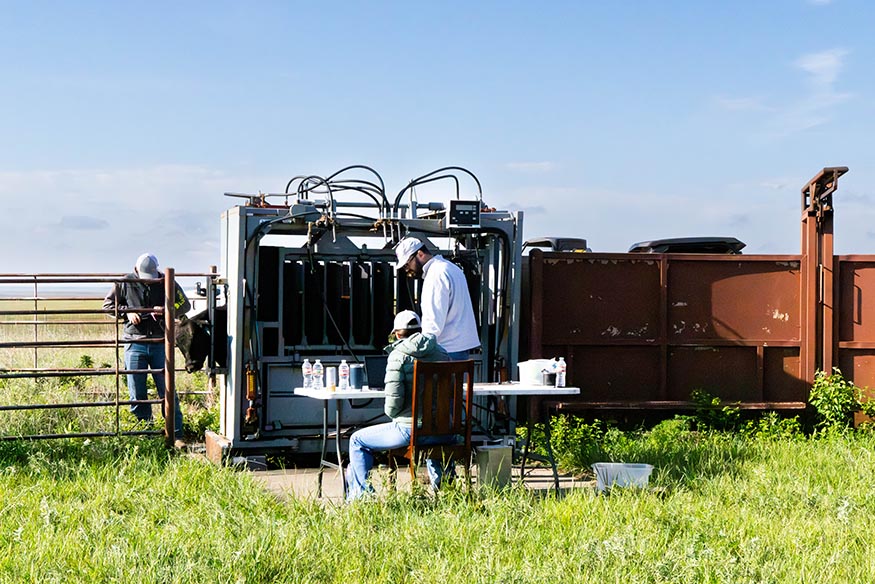 As spring gives way to summer, the 2026 grazing season has officially started at the Hilas Bay and Emma Browning Flint Hills Prairie Preserve, affectionately known as Rannells Ranch. It will be a busy summer of research and outreach, with collaborators across the College of Agriculture involved in ranch activities.
Collaboration began well before cattle were turned out to grass in early May, when annual spring burns were conducted. The Konza Prairie Biological Station joined the Rannells Ranch team again this year to help conduct prescribed burns safely and effectively.
Additionally, Katie Starzec, associate professor of agricultural and natural resources communications, collected time-lapse images of the burn in progress. Prescribed fire is critical to the health of the Flint Hills prairie ecosystem and helps provide high-quality summer pasture for stocker cattle, ultimately improving animal performance.
This summer’s research efforts are centered on three primary cattle projects. The first project is led by Colin Tobin, assistant professor of range science and associate director of Rannells Ranch. The project uses GPS ear tags to collect information about cattle grazing behavior under different stocking rates, such as two acres per animal compared with three acres per animal. Grazing behavior and pasture utilization are influenced by grazing pressure, forage preference, and supplementation locations, among other factors. The project aims to better understand the what, when, where, and why of cattle grazing behavior.
The second project, led by graduate student Jace Owen, examines a supplement called Agolin, sponsored by Alltech, and its potential to improve animal performance while reducing greenhouse gas emissions from grazing cattle. This is the fourth project Kansas State University has conducted on the product and is a collaborative effort between K-State Olathe and the Department of Animal Sciences and Industry. Earlier studies demonstrated the compound can help reduce greenhouse gas emissions from methane produced during the digestive process of ruminant animals. Those findings provide the foundation for this study, which will offer more precise information on animal performance.
The third project marks the beginning of a multiyear grazing systems study examining how animal weight affects range health and cattle performance. Heavier stocker cattle, typically weighing 700 to 800 pounds, are now more common than in previous decades because of changes within the beef industry. While previous stocking rate recommendations provide guidance on the number of pounds of cattle that should be stocked per acre, the long-term effects of stocking only heavier cattle on range health remain underexplored. Researchers hope the project will provide new insights over the next three to five years.